Showing posts with label Jamaica animals. Show all posts

Saturday, May 4, 2013

Facts about the Jamaican Blackbird


The Jamaican Blackbird is a small bird covered with black feathers, as the name suggests. What’s interesting to know is that majority of this bird’s life is spend with its partner, making it monogamous. It is considered to be heard more than sees, primarily because of its distinctive songs and call for its partner. Unfortunately, this bird is also the most endangered in Jamaica.

Physical Description and Behavior
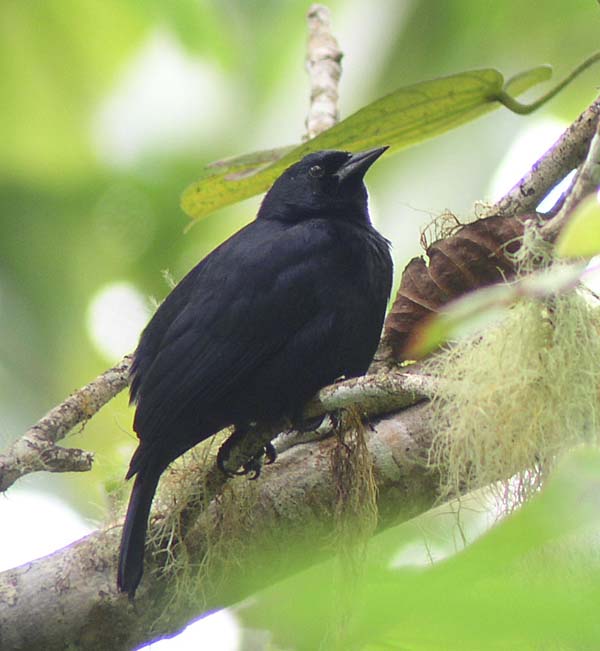

The blackbird has a pointed and curved bill and has a short tail. This specie is endemic to the country of Jamaica. They spend mostly of their entire life in tree canopies. Jamaican blackbirds feed on invertebrates like insects to survive. Mostly, their diet is found on inner branches making it similar to woodpeckers. Their nests are composed primarily of orchids constructed between trunks of trees. As mentioned earlier, these birds are loyal to their partners spending the rest of their lives with just one partner. Usually, blackbirds’ eggs are laid between May and July, and it takes fourteen days for incubation, while the male blackbird is watching over the nest for possible threats.
The Jamaican blackbird has short legs but longer claws; the short tail is useful in climbing up branches. They also have adapted stronger jaws for hammering and probing. 

Habitat  

This bird lives on wet forests with abundant epiphytes or air plants, since they are depending on those for food. At present, it lives in one region in Jamaica, the Cockpit country to where it is protected. As you know, Jamaican blackbird is in serious threat against several factors that’s why it needs to be preserved in a specific area. In the wild, it avoids places affected by strong winds. 

Main Threats

Jamaican blackbird is critically endangered. The principal threat accounts to loss of habitat. Several innovations like establishment of coffee plantations, small-scale farming and charcoal-making are responsible to destruction of their natural habitat. The blackbirds are primarily affected for they depend mostly on large trees with ferns and aerial plants for survival. As construction companies cut down trees for clearing areas to be developed, they are also cutting down the chance of these blackbirds to leave peacefully in the wild.

Photo credits to: http://birdingblogs.com/

Wednesday, January 30, 2013

Endangered Animals in Jamaica


Jamaica’s diversity when it comes to wildlife is not a secret to many. But despite its natural richness, it’s sad to know that varieties of animal species are already or some are near to extinction. However, their government has been striving hard to save these existing species. Here we have listed some of the nearly extinct species and the factors that brought them to such situation.

The Jamaican Iguana

Being the island’s largest land animal, this specimen has invited interests within or outside the island. It is the rarest specie of lizard in the world with just about 50 individuals alive.  The Jamaican Iguana is on the endangered list since adult population is thought to be only 200. Threats to this animal include burning of charcoal by locals resulting to destruction of their natural habitat and also some other animals like namelycats and dogs.

The Jamaican Boa

Also known as the yellow snake, this animal is identified with its black and yellow color. It is widely distributed in the island with a length of about 3 meters. Deforestation and development are the primary factors of extinction. Moreover, it has been reported that people are killing them fearing that they are poisonous, but they’re actually not.

The Jamaican Giant Swallow Tail Butterfly

This is the largest butterfly of the Americas and Caribbean Islands having a wingspan of six inches. The swallowtail is now only found on isolated parts of the island. Main threats are loss of habitat and illegal commercial collecting.

American Crocodile

Being the only family of crocodiles living in Jamaica, it is one of the largest reptiles in the island. They inhabit wetlands along the Southern Coast. Extinction is due to decline in their natural habitat.

The Jamaican Blackbird

Jamaican Blackbird became extinct primarily because of loss of habitat. It can only be found in Jamaica’s Cockpit Country, an area for conservation of different species. The decline in habitat is due to bauxite mining, and significantly, afforestation. Removal of trees for burning and coffee plantation are other contributory factors.

The Jamaican Petrel

Also known as the Blue Mountain Duck, petrel is a small seabird that remains on the critically endangered list. This species was last collected in 1879nd has a drastic decline in number in the 19th century. The presumed cause of its loss is predation of introduced rats which took eggs and mongooses that take incubating adults.